well well...
who didn't know about math?? :)
the most POWERFULL lesson at school, no.1
this time lets find a little truth about math...
the MYSTERY on it (spoooooooky)
The area of study known as the history of mathematics is primarily an investigation into the origin of discoveries in mathematics and, to a lesser extent, an investigation into the mathematical methods and notation of the past.
Before the modern age and the worldwide spread of knowledge, written examples of new mathematical developments have come to light only in a few locales. The most ancient mathematical texts available are Plimpton 322 (Babylonian mathematics c. 1900 BC), the Rhind Mathematical Papyrus (Egyptian mathematics c. 2000-1800 BC) and the Moscow Mathematical Papyrus (Egyptian mathematics c. 1890 BC). All of these texts concern the so-called Pythagorean theorem, which seems to be the most ancient and widespread mathematical development after basic arithmetic and geometry.
The Greek and Hellenistic contribution greatly refined the methods (especially through the introduction of deductive reasoning and mathematical rigor in proofs) and expanded the subject matter of mathematics. The word "mathematics" itself derives from the ancient Greek μάθημα (mathema), meaning "subject of instruction". Chinese mathematics made early contributions, including a place value system. The Hindu-Arabic numeral system and the rules for the use of its operations, in use throughout the world today, likely evolved over the course of the first millennium AD in India and was transmitted to the west via Islamic mathematics. Islamic mathematics, in turn, developed and expanded the mathematics known to these civilizations. Many Greek and Arabic texts on mathematics were then translated into Latin, which led to further development of mathematics in medieval Europe.
From ancient times through the Middle Ages, bursts of mathematical creativity were often followed by centuries of stagnation. Beginning in Renaissance Italy in the 16th century, new mathematical developments, interacting with new scientific discoveries, were made at an increasing pace that continues through the present day.
Indian mathematics
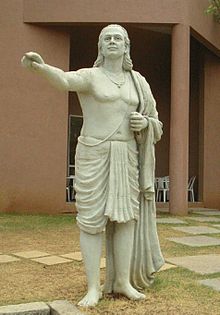
Statue of Aryabhata. As there is no known information regarding his appearance, any image of Aryabhata originates from an artist's conception.
The earliest civilization on the Indian subcontinent is the Indus Valley Civilization that flourished between 2600 and 1900 BC in the Indus river basin. Their cities were laid out with geometric regularity, but no known mathematical documents survive from this civilization.
Vedic mathematics began in India in the early Iron Age. The Shatapatha Brahmana (c. 9th century BC), which approximates the value of π, and the Sulba Sutras (c. 800–500 BC) were geometry texts that used irrational numbers, prime numbers, the rule of three and cube roots; computed the square root of 2 to one part in one hundred thousand; gave the method for constructing a circle with approximately the same area as a given square, solved linear and quadratic equations; developed Pythagorean triples algebraically, and gave a statement and numerical proof of the Pythagorean theorem.
Pāṇini (c. 5th century BC) formulated the rules for Sanskrit grammar. His notation was similar to modern mathematical notation, and used metarules, transformations, and recursion. Pingala (roughly 3rd-1st centuries BC) in his treatise of prosody uses a device corresponding to a binary numeral system. His discussion of the combinatorics of meters corresponds to an elementary version of the binomial theorem. Pingala's work also contains the basic ideas of Fibonacci numbers (called mātrāmeru).
The Surya Siddhanta (c. 400) introduced the trigonometric functions of sine, cosine, and inverse sine, and laid down rules to determine the true motions of the luminaries, which conforms to their actual positions in the sky. The cosmological time cycles explained in the text, which was copied from an earlier work, correspond to an average sidereal year of 365.2563627 days, which is only 1.4 seconds longer than the modern value of 365.25636305 days. This work was translated into to Arabic and Latin during the Middle Ages.
Aryabhata, in 499, introduced the versine function, produced the first Indian trigonometric tables of sine, developed techniques and algorithms of algebra, infinitesimals, and differential equations, and obtained whole number solutions to linear equations by a method equivalent to modern methods, along with accurate astronomical calculations based on a heliocentric system of gravitation. An Arabic translation of his Aryabhatiya was available from the 8th century, followed by a Latin translation in the 13th century. He also gave a value of π corresponding to 62832/20000 = 3.1416. In the 14th century, Madhava of Sangamagrama found the Madhava–Leibniz series, and, using 21 terms, computed the value of π as 3.14159265359.
In the 7th century, Brahmagupta identified the Brahmagupta theorem, Brahmagupta's identity and Brahmagupta's formula, and for the first time, in Brahma-sphuta-siddhanta, he lucidly explained the use of zero as both a placeholder and decimal digit, and explained the Hindu-Arabic numeral system. It was from a translation of this Indian text on mathematics (c. 770) that Islamic mathematicians were introduced to this numeral system, which they adapted as Arabic numerals. Islamic scholars carried knowledge of this number system to Europe by the 12th century, and it has now displaced all older number systems throughout the world. In the 10th century, Halayudha's commentary on Pingala's work contains a study of the Fibonacci sequence and Pascal's triangle, and describes the formation of a matrix.
In the 12th century, Bhaskara first conceived differential calculus, along with the concepts of the derivative, differential coefficient, and differentiation. He also stated Rolle's theorem (a special case of the mean value theorem), studied Pell's equation, and investigated the derivative of the sine function. From the 14th century, Madhava and other Kerala School mathematicians further developed his ideas. They developed the concepts of mathematical analysis and floating point numbers, and concepts fundamental to the overall development of calculus, including the mean value theorem, term by term integration, the relationship of an area under a curve and its antiderivative or integral, the integral test for convergence, iterative methods for solutions to non-linear equations, and a number of infinite series, power series, Taylor series, and trigonometric series. In the 16th century, Jyeshtadeva consolidated many of the Kerala School's developments and theorems in the Yuktibhasa, the world's first differential calculus text, which also introduced concepts of integral calculus. Mathematical progress in India stagnated from the late 16th century to the 20th century, due to political turmoil.
i can't believe such a person who can predict time, day, and year period that have match a modern calculation... (and its began at past when calculator doesn't exist Xp)
such a misterious mathematics calculation...!!!
yooooosh back to work, i wanna help 'my world', find an answer of her math problem (its a 6th grade level, i hope i wont disappointed her T.T)
NJA ^_^







Recent Comments